
Position
Scale is
a decision.
You raised the round. Hiring doubled. Delivery got slower. Stealth Scale fixes the design problem underneath; architecture, organization and process get redesigned as one.
The first call is a working session, not a pitch.
Twenty years of engineering · Booking.com · Airwallex · Turnitin
Problem
Growth doesn't fail. Design does.
Most scale-ups hit the same wall. Capital arrives, headcount doubles; delivery slows down. The cause is rarely the technology alone: it is organizational debt. Decision structures, team boundaries and architecture designed for a company half your size, quietly taxing every release. Technical debt is the symptom; the design of the organization is the cause.
The Triple Failure
The Leadership Gap
Visionary founders, brilliant teams; nobody who has run engineering at scale. Battle-tested technical leadership is the scarcest resource in European tech.
The Invention Tax
Venture capital evaporates into rebuilding infrastructure the industry standardized years ago. Money meant for innovation goes to repairing the foundation.
The Regulatory Wall
NIS2, DORA, CRA, the AI Act: active law, not a future scenario. Companies that are not compliant by design face existential legal and financial risk.
Approach
Enterprise Design.
One integral redesign of organization and technology, not another slide deck. Design the system correctly and compliance stops being a project; it becomes a byproduct.
Architecture
The hard system questions: what must not change, what must stay cheap to change, and how the platform anticipates the next order of magnitude.
Organization
Team topology, governance and decision-making designed for autonomy: minimal dependencies, maximum execution speed.
Process
Delivery that stays fast as you grow. If a process doesn't speed the team up, it goes.
Capital efficiency
OPEX and CAPEX with an architect's discipline: capital should convert into product and valuation, not into meetings.
Every engagement leaves working systems, blueprints and standards behind: assets your teams own and operate. Your independence, not my retention.
Engagement
An engagement in four moves.
01
Audit
A deep, paid analysis of the status quo: where organizational debt sits, and how ready you are for the audits investors will run.
→
02
Blueprint
The target architecture and the organization to run it; decisions documented, trade-offs explicit, sequenced for delivery.
→
03
Implementation
Rolled out with your teams, not around them: platform, processes, and the culture shift to operate both.
→
04
Handover
Knowledge and systems transferred until I am redundant. The organization runs autonomously on the new foundation.
→
Who this
is for
Startups building the first real version of the thing. Series A–D scale-ups past the initial chaos and stuck in complexity. Established organizations that run on software and need serious technology leadership; it does not have to be a hip tech company for the same design problems to apply.
The trigger is usually a funding round, an audit, or delivery velocity falling off a cliff. For founders and boards who see that more budget alone won't fix it. Two or three engagements at a time; that is the whole model.
Raising
soon?
The Audit also runs standalone. Preparing a round? I run the full technical and organizational due-diligence review across architecture, security, team topology and process, and leave you a prioritized improvement plan your teams can execute before investors start asking questions. Pass their audit before they run it.
How this
differs
Interim CTOs sell hours. When they leave, the organization relapses. Here, assets remain.
Audit firms deliver findings. A checkbox is not an architecture; someone still has to build it.
Integrators bill for complexity. My model rewards making myself unnecessary.
Client
Working with Roy Klopper as our Chief Architect has been consistently valuable. He has a sharp ability to understand the needs of both leaders and small teams, and to translate those needs into the tools and structures required to scale fast, from a leadership perspective as much as a technology one.
For me personally, Roy has mentored me as a co-founder on both growth and technology, and helped me as a non-technical CEO strategically steer the company from a software development perspective, something I could not have done alone.
What stands out is how quickly he arrives at clear, well-placed answers. He draws on concrete examples from past experience, which shortens the distance between problem and solution, and gives you real confidence in the direction. He is ambitious, delivers at a consistently high level of quality, and is genuinely fun to work with.
If you are trying to build an organisation from the idea stage or take your product into a new direction, Roy is exactly the person you want in the room.
About
The operator behind it.
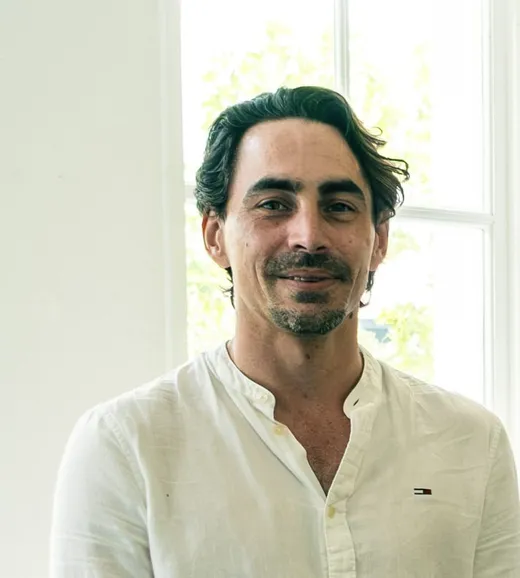
Roy Klopper · Founder
Twenty years from hands-on engineering to the boardroom: Booking.com, Airwallex, Turnitin, and CTO/VP roles across European scale-ups. The work lives at the intersection of people, process and technology: I speak the language of the programmer and operate at the level of the board and the investor.
Booking.com
Architect & Engineering Manager
Compliance-critical systems (DSA/DMA, KYC) and high-performance engineering teams at global scale.
Airwallex
Engineering Manager / Lead
Built the Amsterdam engineering hub of a fintech unicorn; operational capacity in hypergrowth.
Turnitin
Principal Engineer
Distributed systems and on-premise Kubernetes at scale.
Whoppah / Embrace
Creative Technologist (CTO) / VP Engineering
Integral leadership across people, technology and budget; abstract business goals to concrete execution.
Principles
People
Psychologically safe teams outperform heroics, and keep outperforming them at twice the size.
Process
Governance should speed delivery up, not police it. Lightweight, explicit, lived.
Technology
Architecture is the art of deciding what must not change, so everything else stays cheap to change.
Current focus
Governing the agentic workforce: adopting AI in engineering with judgment, ethics and control, as software increasingly acts on its own.
Writing
Occasional notes on scaling.
Contact
Start the conversation.
Directly
The first call is a working session, not a pitch. Bring your hardest scaling question.
Book an intro call · 30 minutesRather not do forms? Message me on LinkedIn ; I answer those too.